what is the best technique to use to control for sequencing effects?
Is at that place a correct guitar pedal order? Every guitarist will move into using effects pedals in their signal concatenation, which is when the chaos starts. What the heck is an effects loop? Why is there more than one output on a pedal? Thankfully, with a decent explanation, you'll find in that location is a logical sequence your furnishings should be in. Today we explain what that lodge is and why...
This nightmare question gets asked one time per musician, they spend a couple days tormenting themselves over it, then information technology finally all clicks into identify. That question?
"What's the best order for my guitar pedals?"
The trouble arises from realizing you may exist using as many equally six or fifty-fifty 12 pedals, and fifty-fifty more on a pedalboard. The number of diverse ways yous tin can mix up the signal path climb into the hundreds.
It does sound intimidating when you read platitudes like "There is no official rule on how to do it, and you should pause the rules and experiment considering that's what art is, and you'll invent something new."
Some people even tell you to figure it out yourself, which is equally cool. It developed over decades. No one person is going to just sort it out by themselves over night.
And no. This isn't purely art. It'south at least halfway science and technology if not even more. Fortunately for us most of the choices become reduced downwards and so that the complexity of the state of affairs goes from mind-numbing downwards to very manageable and sensible.
Here's how we're going to bargain with this. First I'll explain to you the v main classifications of effects types and lay out the proper order in respect to those groupings. So I'll explain why it works this style and you'll realize why this is correct.
Yes, y'all can mix information technology up yet you want and get disastrous results, or you can permit reason guide yous so y'all can get professional results. My goal here is to make this make as much sense as possible in the shortest amount of time possible.
Let'south start with some footing rules of logic that will gear up the stage for the order.
The 4 Rules for the Guitar Effects Social club
These are iv broad rules that quickly narrow down the possibilities of the guitar indicate concatenation. And no, "there are no rules" isn't one of them. At that place is a logical guitar pedal order anybody follows.
Dominion 1 - There is a logical gild for groups of effects. Some furnishings remove or add certain corporeality of frequencies, some change the basic shape of the audio waveform, and others react to the shape and amplitude of the waveform.
Those are iii main types of effects that logically tin can't come in whatever other order than they were just listed, or you end upward with amateur results. The reason for that becomes articulate in the next rules.
Dominion 2 - This order is divers past nature and physics. Consider this scenario. You lot scream and your lungs, mouth shape, and vocal chords define the frequencies that come out. Yous loving cup your easily effectually your mouth to shape the waveform and affect the stereo width.
Then your voice goes out into the air and into the Grand Canyon where it bounces around and comes back at you lot with reverb and delay. If you don't at least follow this fundamental order, you'll be too far out of touch with your listeners and yous won't exist able to audio acceptable within the mix of a song.
Dominion 3 - Experimentation occurs within these groups of effects. While these 3 major groupings need to follow a strict order, the effects within those groups can be toyed with to invent new sounds.
For instance, you can utilize a reverb to your echo filibuster or utilise an repeat to your reverb. But that general group of fourth dimension-based effects needs to come at the end of your effects concatenation, regardless.
Dominion iv - The engineering farther defines the society. Let's requite a couple examples here. If you don't use your racket gate before your compressor, you'll increase the book of your noise which renders your racket gate useless.
If you send an impure point like heavy baloney to a harmonizer, the harmonizer volition be very inaccurate, thus yous want to use distortion to the harmonized signal and not the other style around. If you compress before using equalization, the compressor may act on frequencies you don't intend to proceed in the point, thus you lot should EQ showtime.
These four rules lay out the footing logic for why there is a specific ordering for your effects pedals, despite what others may tell you with their lofty ideals and not-businesslike communication.
The Correct Guitar Pedal Order
With the iv base rules established, let me evidence you the actual 5 groups of effects in the society yous'll want to use them, and so nosotros'll explain what each includes and why they're grouped the fashion they are:
- Dynamics
- Filters & Shifters
- Gain
- Modulation
- Fourth dimension
You will never want to stray from the above gild. Information technology is defined by the four ordering rules and will make more sense in one case yous understand what belongs in each grouping. Permit's expect at that and then I'll give you an example indicate path using equally many effects as possible in the effects chain.
Dynamics
The dynamics group contains effects that modify the shape of the waveform in terms of variances in volumes. That is what the term dynamics refers to, which is the rise and falling of amplitudes and the amount of decibels by which they modify.
This group contains two effects pedals, which are the dissonance gate and compressor (and most of the time a volume pedal). You don't want to modify that ordering, considering of the upshot of compression. Information technology reduces the variance betwixt the highest peaks of volume and the lowest.
And if you haven't taken the racket out of your betoken yet using the dissonance gate, your signal-to-noise ratio becomes lower, making it more difficult to take out the noise in a musical fashion (it'll have more abrupt and noticeable moments of silence).
It should be mentioned explicitly that your tuner pedal should get at the very beginning of your betoken path in front end of all others, and disengaged into true bypass mode when not in employ.
Filters & Shifters
The filters and shifters group also shapes the waveform but in a dissimilar fashion than the dynamics group. First and foremost, at present that you lot've gotten rid of dissonance and extreme volume variances, you want to use an equalizer to tweak your tone.
You may curl off extra bass frequencies and increase some loftier frequencies while dipping the mids. Yous want this washed before you employ the more obvious furnishings in the next groupings.
Besides, after EQ, you'll use other types of filters or shifters. Yous may use an envelope filter (too called an auto-wah) or a wah wah pedal to go on to shape the dynamics slightly and affect the frequency response. You lot want to practice this later you've fix your general tone with EQ though.
Included here after the filters are shifters like your standard pitch shifters, harmonizers, or octave pedals. Y'all desire to take care of whatever pitch changing (I'd contend even vibrato should happen here) before yous add together other furnishings into your signal, since they volition react to the sound signal itself.
You don't want to add reverb and and so endeavour to pitch shift, considering the signal you ship becomes also complex and inaccurate for such a precise consequence.
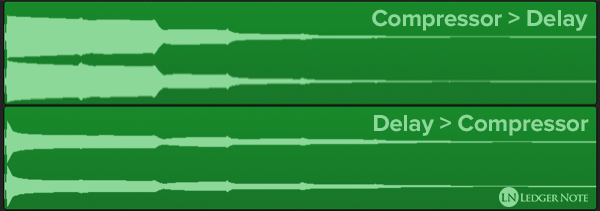
Side Annotation: The in a higher place is a visual example of how the wrong pedal order screws up your tone. When you shrink earlier using delay, yous get a perfectly shaped note ringing out and decomposable uniformly over fourth dimension.
If you delay before compressing and even normalize with your make-upward gain, you still lose volume and power due to the attack sneaking through commencement. Then your delayed notes are all also compressed, ruining your fine-tuned echo disuse so that all echoes are relatively likewise loud and don't disuse equally over fourth dimension.
Gain
The gain group contains effects that are associated with or crave high proceeds. Hither you might employ a boost pedal to increase the book before you feed information technology into baloney pedals, which are too included here. So whether that's a distortion, overdrive, or fuzz pedal, they all belong here.
Yous want this before all of the remaining effects because you want, for example, a distorted point to be delayed, not a delayed signal to be distorted. You tin can try it the reverse way merely y'all'll end up with varying results since the gain will change during reverb tails, decaying delay echoes, and crazy chorus or flanger furnishings.
And since these effects in this group rely on gain, you desire to feed them a consequent and high gain signal, which gets reduced by other effects.
Modulation
The modulation group refers to effects that are cyclically changing the volume signature of your signal or its place in the stereo field past whipping the panning dorsum and forth.
These include choruses, flangers, and phasers (and I'd put tremolo here as well). Because each of these requires duplicating your signal once or several times, you lot desire to practise it after yous've added all of the other dynamic, filter-based, and gain effects.
There is no sense in trying to get a distortion or equalizer pedal to react to a serial of recombined signals when you can take intendance of that before hand. You'll get much higher quality and accurate modulation out of information technology this way.
Time
Finally, nosotros come to our time-based (and infinite-based) effects group. This includes reverb and delay. Both are forms of the same effect with reverb being a much faster version of filibuster.
All they exercise is take the input and "smear information technology out" while reducing the volume over time. Not only does this create an extremely complicated signal that other effects won't react to well, but the variances in volumes these create would further confuse the previous pedals.
If you want another way to think about this, we've previously discussed the types of guitar pedals in a way that organized them differently. It'south nearly the same with more than sub-categories, substantially. Simply if yous're however confused, this expect from another angle might help.
Ii Example Guitar Effects Pedal Orders
Equally you lot tin can see in a higher place, our iv logical rules virtually demand that our five pedal groups come in the lodge they come in, and even within the groups there isn't much room for changing things around, except for the modulation group.
Let'southward at present look at two real-life examples of what this would look similar with a realistic setup. Our get-go case will be a linear sequence without an effects loop, while the second will use an amplifier effects loop.
It should be noted that many pedals themselves can host their own effects loop, and then how you set it upwards is up to you lot. It functions the same either way as long as your can mentally continue rail of the linear guitar pedal order.
First Guitar Pedal Lodge Example
Here is an example of a linear signal path from guitar, through pedals, to the amplifier.
Guitar > Noise Gate > Compressor > Equalizer > Fuzz > Chorus > Tremolo > Reverb > Amplifier
Go along in heed our 4 fundamental rules and the 5 types of effects and you lot'll see that they hold true in example. Hither is the same example in prototype form:
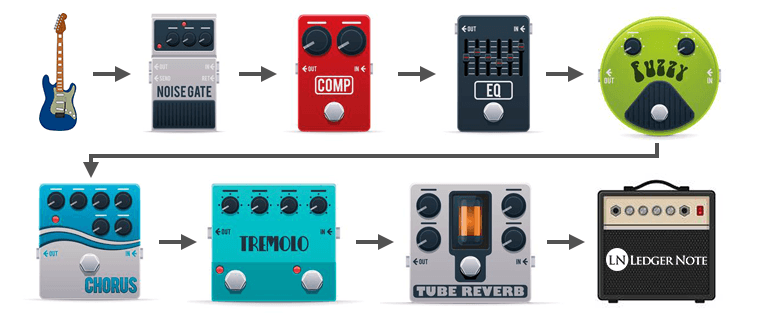
This is the well-nigh directly forward and easy to conceive of method of connecting your guitar pedals in order, because they come up one later another with no additional complications of an effects loop. Allow's discuss what that is then accept a expect at a 2nd case that includes it.
What is an Effects Loop?
A pedal itself can have an effects loop, but the most ordinarily used place is on the amplifier itself. You lot'll come across on virtually amps (merely not all) some course of output labeled every bit Effects Ship or Preamp Out accompanied past an input labeled Furnishings Return or Power Amp In, respectively.
Both sets of outputs and inputs refer to the effects loop that you tin can add together betwixt the preamplifier and the ability amp section of your amplifier.
The primary reason this exists is because some players prefer to drive their amplifier'due south preamp with high proceeds to attain distortion instead of using an emulation through a pedal. This means that y'all tin't push modulation and fourth dimension-based furnishings into the preamp since distortion will come afterwards them.
Again, you tin do this just it will audio horrible because it breaks our 4 main rules above. Nobody wants a dirty, smeared, and washed out tone, and thus the effects loop exists.
We should mention that there are series effects loops and parallel ones too. The difference is that parallel splits your betoken while serial treats it like an extension of the linear bespeak path.
Understanding why this is an option doesn't matter right now and doesn't touch on our examples, but don't be surprised if y'all meet it on your amp.
2nd Guitar Pedal Club Example
Our second example includes a effects loop in serial at the amplifier. This doesn't really change your guitar pedal guild since it'south still a linear pathway.
Guitar > Compressor > Equalizer > Pitch Shifter > Boost > Amplifier (Send) > Flanger > Vibrato > Delay > Reverb > Amplifier (Return)
The send and return betoken the start and end of the furnishings loop. Hither it is visually, which should make things much more than articulate:
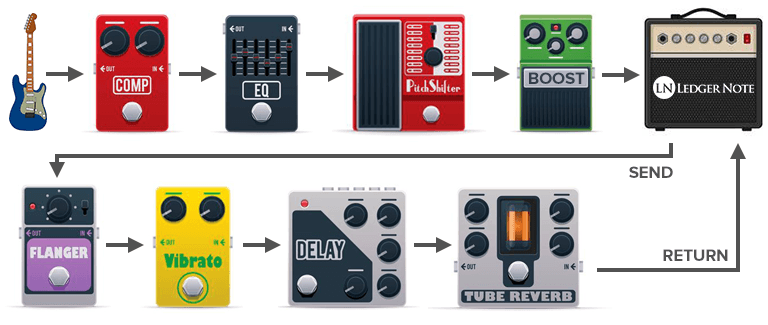
Again, the entire purpose of the effects loop is to permit you to employ your amplifier'south preamp to go natural distortion and then apply modulation and time-based furnishings, rather than having distortion applied to them, which sounds bad.
Your Guitar Pedal Order Matters!
And that's a wrap. If you're new to the pedal game, don't permit anyone tell yous that there are no rules. At that place are some very strict rules that apply if yous want to sound professional, and these rules quickly reduce the amount of options down to very few, indeed.
The honest and realistic among united states of america will tell you the truth that there is a very firm furnishings pedal order you should connect your pedals in that you don't want to devious from unless you desire to ruin your tone and appear to not know what you're doing. Guitar pedal order matters!
Jared H.
 Jared has surpassed his 20th year in the music manufacture. He acts equally owner, editor, lead author, and web designer of LedgerNote, besides as co-writer on all articles. He has released 4 independent albums and merchandise to global sales. He has also mixed, mastered, & recorded for countless independent artists. Learn more than almost Jared & The LN Team here.
Source: https://ledgernote.com/columns/guitar-guru/guitar-pedal-order/
0 Response to "what is the best technique to use to control for sequencing effects?"
Post a Comment